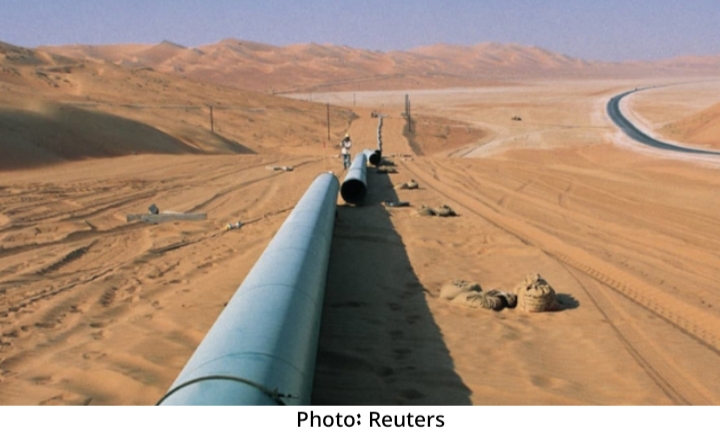
Amid rising tensions in the Middle East, Saudi Arabia’s East-West pipeline has reached full operational capacity, transporting approximately 7 million barrels of oil per day while bypassing the Strait of Hormuz.
According to international media reports on Saturday, exports of Saudi crude oil from the Red Sea port of Yanbu have significantly increased, reaching around 5 million barrels per day. In addition, the country is exporting between 700,000 to 900,000 barrels of refined petroleum products daily to global markets.
However, these figures could not be independently verified immediately. Reuters attempted to contact Saudi Arabia’s state-owned oil giant Aramco for confirmation but did not receive an official response.
Earlier in March, Aramco CEO Amin H. Nasser indicated during a conference call that the East-West pipeline was expected to reach full capacity within days, driven by shifting export routes.
Analysts suggest that escalating tensions in the Gulf region—following joint military actions involving the United States and Israel in Iran—have disrupted global energy supply chains. This has also led to instability in international shipping operations.
Meanwhile, Iran’s effective restriction of the Strait of Hormuz has put nearly one-fifth of the world’s oil and liquefied natural gas supply at risk. As a result, global crude oil prices have surged, surpassing $100 per barrel.
Saudi Arabia’s ‘East-West’ pipeline bypassing the Strait of Hormuz is at full capacity, transporting 7 million barrels of oil daily