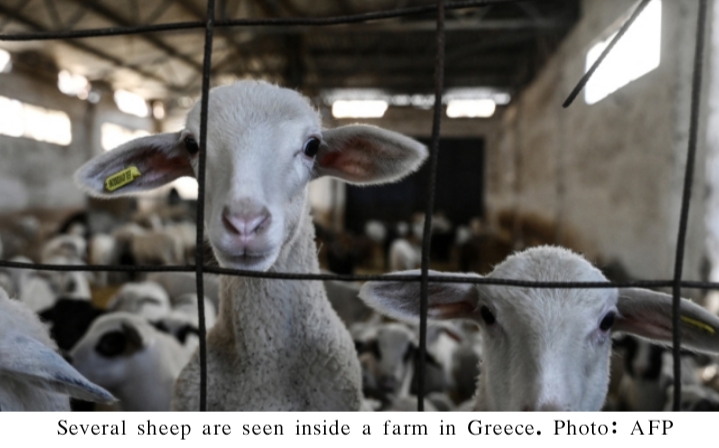
Since August 2024, more than 480,000 sheep and goats have been culled in Greece to contain a widespread outbreak of a springtime livestock disease. Farmers report that the large-scale culling has caused a significant drop in meat and milk production, putting Greece’s key export product, feta cheese, at risk.
Greece’s premium cheese industry depends largely on milk from locally raised sheep and goats. The mass culling has left many Greek farmers financially ruined and has also negatively impacted the dairy sector.
AFP spoke with farmer Kostas Theofilou, who stood silently in his now-empty barn. He said, “The livelihoods of three families depended on these animals. Look at the damage it has caused. At 55, what else can I do now?”
Theofilou’s farm, once alive with the bleating of sheep and the ringing of their bells, is now eerily silent. Even the dogs, longtime companions of the shepherd, wander around listlessly. “I have worked as a shepherd all my life,” Theofilou told AFP. “I have no other work experience. I only know sheep.”
About 45 percent of feta cheese production comes from the Thessaly region, made mainly from sheep and goat milk. The spring outbreak has significantly disrupted cheese production, with milk output falling by 40 percent this year.
Authorities have introduced several measures to prevent the disease from spreading. Under the new rules, animals can no longer graze freely in open fields, except on farms with private pastureland. Farmers are required to keep their livestock in barns and provide food there.
Farmer Georgios Zenitidis, 59, said, “Since September 9, I have not let my animals out of the barn.” Recent colder weather has helped reduce the outbreak, and many farmers are vaccinating their livestock with doses imported from Bulgaria and Turkey. Although such vaccines are officially banned in Greece, veterinarians report that these measures are showing some positive results as farmers take risks to protect their livelihoods.
Nearly 500,000 cattle slaughtered in Greece in 2 years