

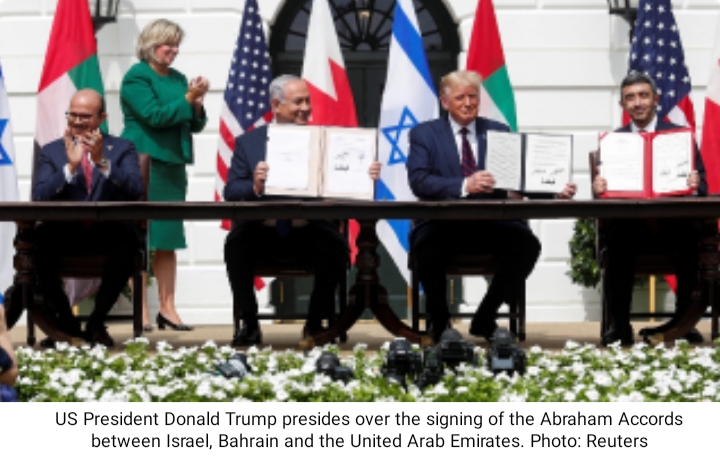
The Abraham Accords were once presented as a historic pathway toward peace in the Middle East, but analysts now argue that the agreement has instead contributed to rising tensions and laid the groundwork for a broader confrontation between Iran and Israel. In a recent analysis published by Foreign Policy on May 7, Matthew Duss, Executive Vice President of the Center for International Policy, and Yuri Linetsky, Research Director at Dandelion Works, claimed that the accords failed to deliver the regional stability that many world leaders had promised.
On September 15, 2020, then–U.S. President Donald Trump hosted the signing ceremony of the Abraham Accords at the White House, bringing together Israel, Bahrain, and the United Arab Emirates in what he described as “the dawn of a new Middle East.” Prominent American diplomats and foreign policy experts, including Dennis Ross and later U.S. Secretary of State Antony Blinken, praised the agreement as a breakthrough capable of reducing regional conflict and creating prosperity across the Middle East. However, the new analysis argues that those expectations were largely unrealistic.
According to the authors, the so-called “outside-in” strategy behind the Abraham Accords attempted to normalize relations between Arab states and Israel while sidelining the Palestinian issue. Rather than resolving tensions, they argue, the process empowered Israel politically and militarily while deepening regional polarization. The article claims that the accords indirectly provided political cover for Israel’s operations in Gaza and strengthened the framework for a future confrontation with Iran.
The report further states that containing Iran was one of the hidden strategic goals of the agreement. This became more visible after the passage of the Israel Relations Normalization Act in 2021 and the Defense Act in 2022 in the United States. During this period, Israel was also moved under the jurisdiction of the U.S. Central Command (CENTCOM), allowing closer military coordination between Israel, Bahrain, and the United Arab Emirates. Analysts argue that this coordination helped establish an integrated regional defense structure aimed primarily at countering Iranian missile and drone capabilities.
The accords also accelerated military and technological cooperation across the region. Gulf states reportedly allowed expanded use of their airspace, increasing Israel’s operational flexibility. At the same time, Israel’s arms exports surged significantly after the agreement. By 2024, approximately 12 percent of Israeli arms sales reportedly went to Abraham Accords member states, totaling nearly $2 billion. Israeli defense firms expanded cooperation in drone systems, cyber surveillance, and advanced aviation technologies with Gulf countries, particularly the UAE. Reports also emerged alleging Israeli intelligence activity at strategic facilities on Yemen’s Socotra Island supported by Emirati funding.
The Abraham Accords themselves consist of a series of diplomatic agreements signed in 2020 under U.S. mediation, through which the United Arab Emirates, Bahrain, Sudan, and Morocco formally normalized relations with Israel. The name “Abraham” was chosen to symbolize the shared heritage of Judaism, Christianity, and Islam through the Prophet Abraham (Ibrahim, peace be upon him). The agreements included diplomatic recognition, the opening of embassies, direct flights, trade partnerships, tourism expansion, and increased security cooperation.
Yet critics argue that the security architecture created under the accords contributed to escalating regional conflict. Following the assassination of Iranian commanders in Damascus in 2023 and attacks linked to Iranian diplomatic facilities in 2024, missile and drone exchanges between Iran and Israel intensified sharply. The analysis claims that Gulf allies, including Saudi Arabia and the UAE, provided intelligence and radar support to Israel during parts of these confrontations.
The authors conclude that the Abraham Accords have not brought lasting peace to the Middle East. Instead, they argue, the region has become more unstable, with growing tensions in Gaza, Lebanon, and across the wider Middle East. They warn that relying on military alliances, arms deals, and authoritarian security cooperation while ignoring the Palestinian issue cannot create sustainable peace. Citing former Israeli intelligence analyst Danny Citrinowicz, the article argues that even a change in Iran’s leadership would not resolve the region’s core instability unless the Palestinian question is meaningfully addressed. Ultimately, the analysis presents the Abraham Accords not as a successful peace initiative, but as a strategic realignment that may have intensified conflict rather than resolved it.