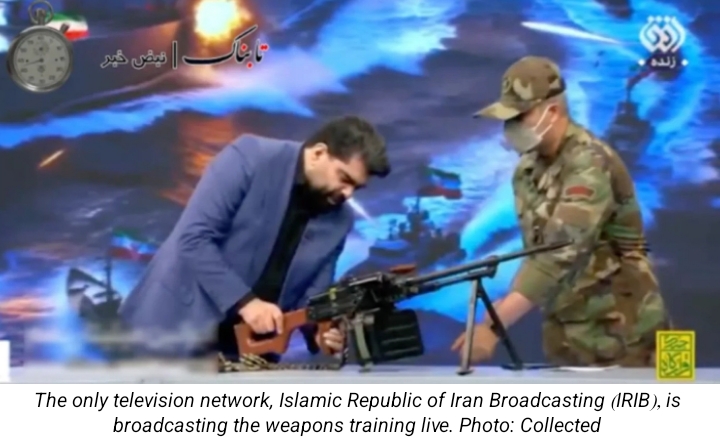
Iran’s state television has begun broadcasting weapons training programmes, including demonstrations on how to assemble and disassemble Kalashnikov rifles and PK machine guns, marking a notable shift in the country’s public broadcasting content. The Islamic Republic of Iran Broadcasting (IRIB), which operates under hardline influence and whose head is appointed by the Supreme Leader, has aired live segments showing members of the Islamic Revolutionary Guard Corps (IRGC) demonstrating weapon handling techniques. In one controversial live broadcast on Channel Three, an IRGC-clad masked instructor demonstrated firearm usage, after which the presenter reportedly sought permission to fire toward a flag displayed in the studio, which was then carried out on air. In another live programme, a presenter was seen joining pro-government supporters in Tehran and firing shots into the air, later describing the act as symbolic while stating that citizens would take up arms if necessary against any perceived aggression. Reports also indicated that female presenters have participated in similar broadcasts, with one presenter stating she had recently received a Kalashnikov and was prepared to take part in conflict against the United States and Israel if required.
Meanwhile, the US-based Iranian Human Rights Activists News Agency (HRANA) has reported a deterioration in human rights conditions following heightened regional tensions, claiming that thousands of arrests have been made on charges related to national security, espionage, and cooperation with hostile states, along with multiple executions during the same period. These figures have not been independently verified. The reports also allege increased security measures across several Iranian cities, including expanded checkpoints and stricter movement controls.
Separately, Iran’s Red Crescent volunteers have strongly condemned derogatory remarks made on state television regarding rescue dogs used in disaster operations. Rescue personnel emphasized that trained dogs play a critical role in locating survivors trapped under rubble and are an essential part of emergency response teams. The incident sparked widespread discussion on social media, with many users criticizing the tone and conduct of state broadcasting.
At the same time, online debates have intensified over political symbolism in diaspora demonstrations, including the display of controversial flags linked to Iran’s pre-revolution security apparatus. These developments have further fueled discussion about Iran’s internal political climate, state media messaging, and the role of opposition groups abroad, with sharply divided public reactions both inside and outside the country.
Iran conducts weapons training in live broadcast on state TV