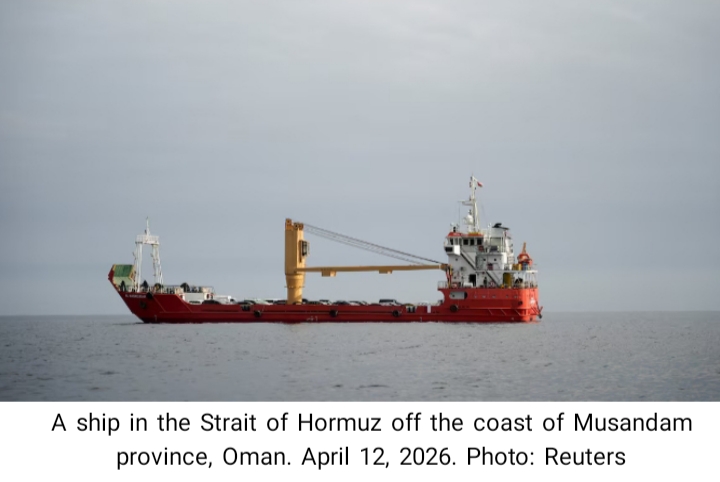
The United States Central Command (CENTCOM) stated in a declaration that “all vessels from any country” traveling to and from Iran’s ports—including coastal areas of the Persian Gulf and the Gulf of Oman—will fall under this blockade. Following the failure of peace talks held in Pakistan without any agreement, the U.S. military announced a blockade on all Iranian ports starting Monday (April 13) to increase pressure on Tehran. On Sunday (April 12) evening, CENTCOM confirmed that from 10:00 AM local time on April 13, the blockade would take effect on all maritime traffic entering or leaving Iranian ports. CENTCOM further clarified that vessels from all countries heading to Iranian ports in the Persian Gulf and Gulf of Oman regions would be subject to this restriction. However, it also noted that ships traveling to non-Iranian ports would not face interference from U.S. forces in the Strait of Hormuz. This appears to be a relatively softer stance compared to earlier threats made by President Donald Trump, who had previously warned of blocking the entire Strait of Hormuz and taking action against ships paying tolls to Iran. A correspondent from Al Jazeera in Washington reported that there are still “many unanswered questions” and noticeable inconsistencies in the U.S. position. He noted that Trump had earlier said all ships entering or exiting the Strait would be targeted, but CENTCOM is now limiting the scope to vessels connected to Iranian ports. Following the U.S. blockade threat, global oil markets reacted sharply, with U.S. crude rising 8 percent to $104.24 per barrel and Brent crude increasing 7 percent to $102.29 per barrel. Since February 28, when the United States and Israel launched military actions against Iran, Tehran has taken control of the strategically vital Strait of Hormuz, disrupting a key global energy supply route. As a result, maritime traffic has nearly halted, affecting around one-fifth of the world’s oil and liquefied natural gas (LNG) supply. Iran has continued its own shipping operations through the strait while allowing limited passage for other nations, and officials have also discussed the possibility of introducing tolls after the war ends. In response to Trump’s blockade threat, the Islamic Revolutionary Guard Corps (IRGC) warned that the presence of any foreign warships in the region would be considered a violation of the existing ceasefire agreement between the U.S. and Iran. The ceasefire is currently set to remain in effect until April 22, and the IRGC cautioned that any such move would be met with “strong measures.” The blockade announcement came immediately after the collapse of peace talks in Islamabad, raising fresh concerns about the possibility of renewed conflict. Iranian officials have blamed the U.S. for the failure to reach an agreement. Iran’s Foreign Minister Abbas Araghchi stated that a memorandum of understanding was “very close” to being signed, but U.S. negotiators disrupted the peace process by changing terms at the last moment. Zahra Kharazmi, an associate professor at Tehran University, said the United States is not in a position to dictate how Iran should behave or which ships may pass. She added that if this blockade turns into a test of endurance between Iran and the global market, it will soon become clear who suffers the most, emphasizing that Iran is fully prepared for a prolonged conflict.
US military announces blockade of all Iranian ports starting today